
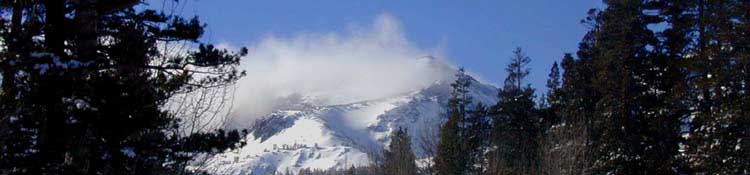
A Season in a Day
The Sierra Crest is noted for having the capacity to produce four seasons of weather during a single Summer Day.
Rain, snow, hail, fog, lightening, and a bit of sunshine can all happen in quick sequence.
Strange Trends
The High Sierras are not just noted for rapid changes in weather and temperature. The High Sierras are also known for sudden appearances of very harsh weather trends. You may experience anything from extended periods of intense heat, bitter cold, Summer snow storms, or tropical-style downpours.
Or you may not. Sierra weather can also be quite placid and delightful. But the Sierra can turn on you in a second, after wearing you out for a week.
This weather page is designed to give you a heads-up about this wild and wide range of weather, and by providing a wide-angle view of current weather conditions from Radar, Satellite, and Maps.
The North, Central, and Southern Sierra pages will have more detailed information, such as real time reporting stations and local forecasts.
Always plan for the historical range of weather possibilities, even if all of the current forecasts, maps, satellites, and ground stations report all is well.
The weather changes quickly in the Sierra Nevada.
Preparation
The Sierra's extremely wide range of weather possibilities must be taken into account, and preparations made to deal with these weather facts BEFORE entering the High Sierras.
The longer your trip lasts, the more likely you are to experience a wide variety of weather conditions, and weather conditions at their extremes.
Recent Times
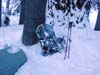
Long Distance Backpackers who were on the High Sierra Crest in early August of 2009 experienced just such a weather extremety: A Summer Snow Storm.
Temperatures dropped to the high teens and low twenties. Snow and hail fell, which partially obscured the trails. All of those who entertained the misconception that the Sierras only have fine weather during the Summertime were bitterly disappointed, but well corrected.
The many backcountry travelers who were not properly prepared were lucky that little series of Summer storms blew apart, rather than consolidated and deepened. I felt really lucky to get to experience them at all.
Afternoon thunderstorms with prodigious lightening and thunder, occassionally accompanied by a torrential downpour, are regular metrological events on the Western slope of the Sierras to the Crest.
I believe it was during the Summer of 2002 that a two week long trend of torrential downpours between 2pm and Sunset drenched the Sierras, and flooded Tuolumne Meadows, wiping out the water, sanitation, and electrical infrastructures.
Big boulders were rolled onto Highway 120 by the surging flood waters in Tuolumne Meadows.
The results are In
During extremes of climate in the Sierras I have encountered two types of backpackers. There are those who revel in engaging with nature at its unexpected extremes, and those who suffer from these extremes.
The difference boils down to expectations.
Summer Backpackers in the Sierra Nevada Mountains should expect to experience these powerful, but brief wonders, and equip yourselves appropriately.
Weather considerations should guide, if not inform your gear selection. |
Big-Picture Weather Checklist for Backcountry Travelers
All Seasons
Regional Radar: Click map for local resources
NWS Western US Satellites
GOES Pacific Ocean Satellites
NWS Weather Maps
National Weather Service
Radar
National Weather Service Resources
Local, Regional, and National radar resources will show you what is happening right there, right now. Almost real-time loops are available for every map.
Note that the regional-sized radar maps will give you an indication of what is headed towards your hiking area from a great distance away.
Heck, that's the whole point of all the assets on this page!
Satellites
National Weather Service
The NWS Satellite resources page, out of Reno, Nevada will give you an excellent orbital view of upcoming potiential storm activity headed towards the Sierra Nevada, and the Western United States, from far over the horizon.
Combine this information with your use of the NWS Radar, Maps and Forecasts, you can prepare yourself for the nature of the incoming weather.
GOES Pacific Ocean Satellites
The GOES Pacific Ocean Satellites will allow you to track storms coming across the N or S Pacific towards the Sierra Nevada.
Pacific Tropical Satellite Imagery: Northeast Pacific
Maps
National Weather Service
NWS Maps Note: Especially Check the 24 to 48 Hour fronts and Precipitation Maps.
These maps are invaluable projections ofthe movement, development, and interaction of high and low pressure zones, and the movement of their interfaces.
Use the current map to orient the information from the satellites and radar to get a context on all this information so you can project change over the time-span of your hike.
National Weather Service
Home Page
The National Weather Service Home Page displays large and small scale weather warnings which may pertain to your High Sierra backpacking plans.
Other Cool Resources
Federal; REGIONAL SNOW ANALYSES: Western Coastal.
NWS WINTER WEATHER FORECASTS
NATIONAL SNOW AND ICE DATA CENTER
All Sierra Web Cams: Sierra Visions
|