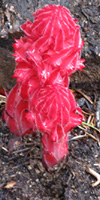

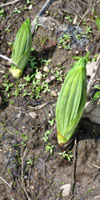
Snowplant
Paperplant blooming
Snowplant, below Round Lake, Meiss Roadless Country Lake Tahoe to Mount Whitney: Your Backpacking Guide to the High Sierras Sprouting Paper Plant
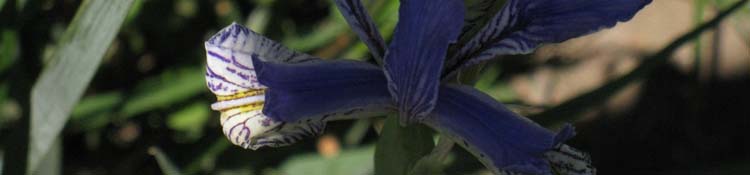
Iris in Shadow in the Carson Gap between the Lake Tahoe Basin and Carson Pass.


The Trails

Guide
Maps
Miles/Ele
Permits
Resupply
Forum


Current Weather Conditions

Weather Notes
Northern High Sierras
Central High Sierras
Southern High Sierras
 

Gear

Gear List
Gettin Started
Layering
Discussion
 
Testing yourself and your gear
 
Gear Reviews


top of page

Backpacking through the Carson Gap

Hiking South out of the Tahoe Basin through the Carson Gap on the Tahoe to Yosemite and Pacific Crest Trails


Languages

Languages


Trail Arts

The art of walking


Physical Preperation


Trail Skills

The trail
Off the trail
Scrambling
Maps
Navigation
Camp skills
 

Food

Resupply
Food


Other

Photo Catagories
 
Trail Stories
 
Trail Culture
 
News and Science
 
Links
 
Groups
 
Books


Terms and Conditions of Use

top of page

Trail Guide This Segment North Carson Gap South TYT Trail to Woods Lake South PCT Carson Pass Topo Map South Upper Truckee to Carson Pass The Carson Pass Map Maps Index Miles and Elevations Miles and Elevations Index Lake Tahoe Basin Management Unit All permitting Authorities Tahoe to Whitney on YouTube

Approaching the Carson Gap from the North, departing the Tahoe Basin

Here at the Carson Gap Southbound hikers must decide between hiking The Pacific Crest Trail or the Tahoe to Yosemite Trail route South toward Tuolumne Meadows.

Just a few feet South through the Carson Gap we encounter the Northernmost of three possible routes to Round Top Lake and the TYT route beyond.

Northbound Hikers are on again on the reunified Pacific Crest and Tahoe to Yosemite Trails. The PCT and TYT last split at the top of Jack Main Canyon where the TYT exited Yosemite through Bond Pass and the PCT through Dorothy Lake Pass.

Southbound hikers on the currently dividing PCT and TYT trails will again rejoin at the top of Jack Main Canyon in Yosemite.

Page Index

Directions

Miles and Elevations North & South: TYT and PCT

Video: Through the Carson Gap

Carson Gap Encounters

Pepperoni and Harmony

Video: Bear & Idiot day Hiker

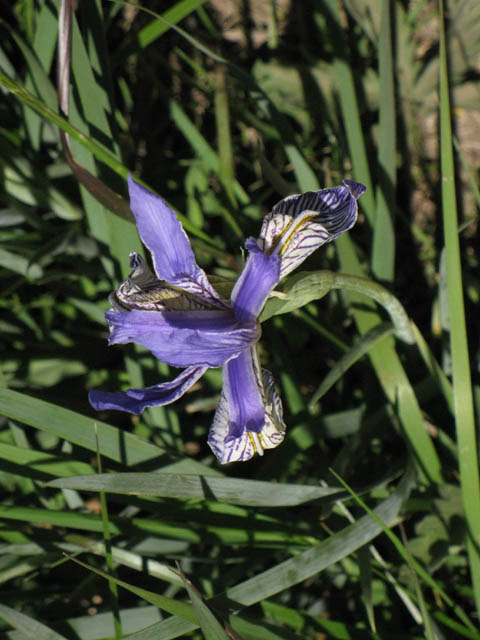
Carson Gap Iris

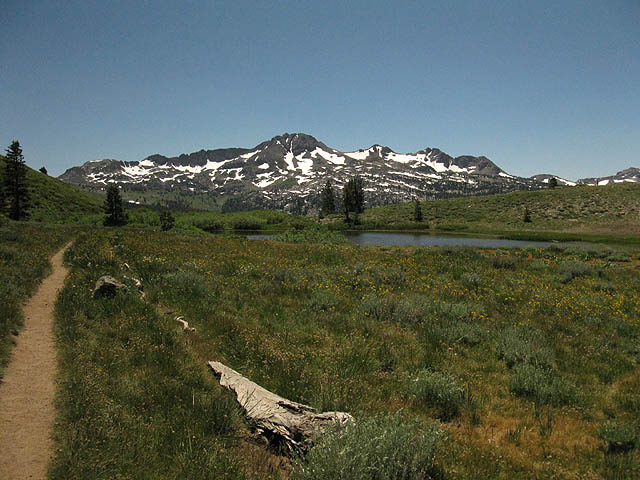
Carson Gap Pond

Butterflies

TYT Junctions

Upper Tahoe Yosemite Trail Juction

Lower Tahoe Yosemite Trail Junction


Route South Options & Information

PCT vs TYT

TYT unmaintained trail section

Thoughts on the upcoming Trails

Backpacking is Dangerous

Next Resupply: Lake Alpine Lodge

South of Highway 4: Carson-Iceberg Wilderness

Sierra Administration and Permits

Short Trips: Carson Pass and Meiss Roadless Area

> Forum <

Views East hiking South up to the Carson Gap

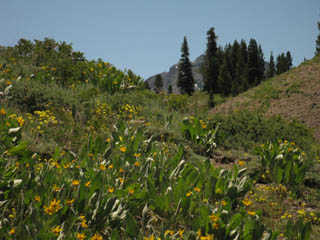
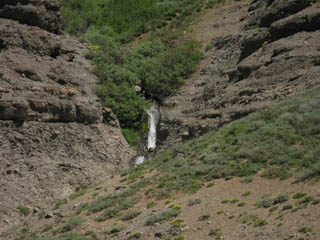
  Paper Plant in full bloom heading up the North side of the Carson Gap.       Waterfall draining off the North side of Red Lake Peak in July, which bounds the Eastern Side of the Carson Gap.  
  Young Paper Plants (ie, "Miner's Cabbage") Just listen to it in Fall!       Waterfall on the way to the Carson Gap  
Otherwise known as Mule Ears. The sound these plants make in Fall breezes sounds like rustling pager in an ancient library. Much of the Eastern Sierra is draped with, if not completely composed of, reddish-hued volcanic rock.  

The Carson Gap

The Carson Gap is the low gap (8800 ft) in the mountains ringing the Southernmost end of the Tahoe Basin. This gap is located at the low point along the Sierra Crestline between the West flank of Red Lake Peak and the ridgeline dropping off the Eastern side of the Little Round Top massif.

The Carson Gap is the lowest point between the peaks ringing Meiss Meadow. Meiss Meadow is the bottom of the South Upper Truckee River's headwaters bowl, and these mountains are the sides. The South Upper Truckee drainage is large and complicated, beginning at Echo Pass and encompassing the totality of the Meiss Country Roadless Area.

On the South side of the Carson Gap the Eastern Sierra flank drains into the West Walker River and the Western Flank into the Silver Fork of the American River.

MAP

The mountains surrounding Meiss Meadow are the Southernmost extent of the Tahoe Rim/Sierra Crest Mountains around South Lake Tahoe.

In any case, the Carson Gap marks the Southbound backpackers deparure from the Tahoe Basin and the uniquely beautiful variety of terrains that decorated our hike down the High Sierra mountains above the Western Shore of Lake Tahoe.

We will realise just how unique the Tahoe Basin is after we hike through a few more National Forests and Wilderness backpacking South. Though each is unique and beautiful, the Tahoe Basin puts together such a variety of terrains physical and cultural terrains it stands out.

From the Carson Gap we exit the Tahoe Basin to continue our Southward trek along the Sierra Crest Line. The question is, South along which trail? The TYT or the PCT?

We must decide quickly. I hope you have already decided and packed properly for your chosen route. Because a few yards down the South side of Carson Gap we will find the first of three trail junctions where the PCT and TYT routes part company near Carson Pass.

PCT vs TYT

From the Carson Gap the great Massif of Round Top and the Sisters dominates our Southern view. This piece of rock is also the dominant feature of our route decision. How we pass South of this feature determines our route.

PCT

The Pacific Crest Trail route turns Southeast around Round Top to trace its Southbound route along the volcanic dominated Eastern flank of the High Sierra.

27 miles South of our position at the Carson Gap the Ebbetts Pass sits on Highway 4.

See this topo hiking map which marks the location of the Carson Gap in relation to both the Tahoe to Yosemite and Pacific Crest Trails. Click the Colored dots along each route, and you will be brought to the corresponding trail guide page, where you can examine each location and both routes in detail.

TYT

The Tahoe to Yosemite Trail hikes up to Round Top Lake sitting just below The Sisters. The TYT route rounds the Southwest flank of the Western Sister to set a line Southwest towards Lake Alpine through the granitic Western Flank of the Sierras. Lake Alpine is situated about 15 miles West of Ebbetts Pass on Highway 4.

Backpackers on the Tahoe to Yosemite route encounter the first of three possible trail junctions to the TY Trail just a few steps to the South of the Carson Gap. (see below) The second junction sits at the bottom of the South flank of the mountain below Carson Gap, (also below)and the third junction to the TY trail is through the Winnamucca Lake Junction a mile South of Carson Pass on the Pacific Crest Trail. Our first question is which of the three routes to the TYT should we hike?

The first two junctions to the TYT are unmarked trail junctions that lead you down well-trod trails to the same location on Highway 88 West of Carson Pass, and on towards Woods Lake to offer two distinct approaches to Round Top from the North. The third trail junction is the well marked Winnamucca Lake trail junction that is located on the Pacific Crest Trail route a mile South of Carson Pass. This route approaches Round Top from the East.

There are no trail junctions labeled "The Tahoe to Yosemite Trail" in the Carson Pass region, though there are three ways to get to the Western Flank of Round Top and The Sisters to follow the Tahoe to Yosemite route into the great granite valley holding Summit City Creek.

Carson Gap Forum Page

Comments-Questions

top of page


Exiting the Meiss Country Roadless Area and the Lake Tahoe Basin Southbound through the Carson Gap

The Carson Gap

Elevation: 8800 feet

North

1.52 Miles to Meiss Cabin.        3.4 miles to Showers Lake.         10.61 miles to Echo Summit

South

1.39 miles to Carson Pass PCT.   27.88 miles to Ebbetts Pass PCT.   3.4 miles to Round Top Lake TYT.

24.81 miles to Lake Alpine TYT.

Mileages North
Combined PCT & TYT
Carson Pass to Echo Summit: 12
Echo Summit to Meeks Bay: 30.71
Total: Carson Pass to Meeks Bay: 42.71

Note: South of the Carson Gap the PCT and TYT routes split until they rejoin below Bond Pass in the Yosemite Backcountry.

North of the Carson Gap the PCT and TYT again divide .82 of a mile North of Middle Velma Lake. Here the TYT cuts Northeast towards its Trailhead at Meeks Bay while the PCT continues North along the West Shore of Lake Tahoe.

The TYT trailhead at Meeks Bay is the Northern limit of this guide for the Pacific Crest Trail. The Southern limit is Crabtree Meadow West of Mount Whitney.

Mileage South
Pacific Crest Trail
Carson Pass to Ebbetts Pass: 27.1 miles

Ebbetts Pass to Sonora Pass: 29.44 miles

Sonora Pass to Tuolumne Meadows: 73.8 miles

Total: Meeks Bay to Tuolumne Meadows: 173.05 miles


Southbound PCT Information
Pacific Crest Trail route
To the Carson Pass: Trail Guide
Carson Pass Region Topo Map
Carson Pass to Ebbetts Pass: Topo Hiking Maps
Miles and Elevations

Southbound Hikers

Southbound backpackers have a choice between continuing South on the Pacific Crest Trail or the Tahoe to Yosemite Trail.

For information about the differences between your two route options South read the route discussion below, and find more information and links on the Carson Gap Forum Page, where you can also leave comments and questions.

 
Mileage South
Tahoe to Yosemite Trail

Carson Gap to Lake Alpine: 24.81 miles

Lake Alpine to Saint Marys Pass: 34.64 miles

Kennedy Meadows to Tuolumne Meadows: xx.xx miles


Southbound TYT Information
To Round Top Lake: Trail Guide
Carson Pass Region Topo Map
Carson Gap to Lake Alpine: Topo Hiking Maps


Miles and Elevations


Total: Meeks Bay to Tuolumne Meadows:

Comments-Questions

top of page

Video: Backpacking through the Carson Gap looking South at our Tahoe to Yosemite and Pacific Crest Trail options

This video gives you a look at the Carson Gap, where the Southbound backpacker on the Tahoe to Yosemite trail departs the Pacific Crest Trail to head to Lake Alpine on Highway 4 along the Western flank of the Sierras. The PCT tracks along the Eastern flank of the Sierras and intersects with Highway 4 at Ebbetts Pass.

top of page

Encounters at the Carson Gap

Cowgirls in the High Sierras

Trail Culture

Equestrian Pacific Crest Trailer

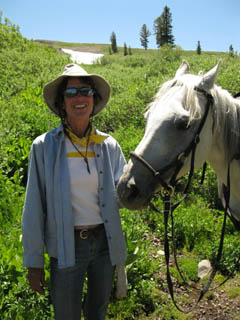
Janice "Pepperoni" Raddatz and Harmony
  Half-way up to the Carson Gap I encountered Pepperoni and Harmony coming down.  
   
They were both in good Cheer.


Pepperoni and Harmony

I encountered Pepperoni and Harmony on the North Side of the Carson Gap on July 16, 2009. They were heading North, and I South.

This horse carried Pepperoni Northbound across the Sierras during the early Spring when they were full of snow. This was a real accomplishment for both horse and rider. I find that the Sierras are very challenging in Spring Conditions for backpackers, and can only imagine these challenges on horseback.

But horses are amazing mountain climbers. I have seen cowgirls riding up steep mountain trails that the misinformed would believe impossible for a horse. Not so. I've also seen a bear climb a granite rock face, but that's a different story, for later. But don't underestimate the climbing ability of horses or bears in the mountains.

The horse was wearing a few scrapes from hitting submerged objects in the snow, but was looking sharp and lively. A very well tuned creature, by my accounting. Some Young horses' skittishness is perfectly tuned to the environment. Harmony was such a horse, apparently closely observing everything in the surrounding terrain. I was happy to share the trail with both, and was fortunate to meet this team before I cut off of the Pacific Crest Trail at the Carson Gap to follow the Tahoe to Yosemite South. That junction would mark the end of encounters with Pacific Crest Trailers until rejoining the PCT in the Northern Yosemite backcountry below Bond Pass.

I departed the trail through the Whitney Portal on August 28, finally returning home in early September. I looked up Pepperoni and found her to be Janice Raddatz, and checked her website.

On her site I found a notice that she had a wreck up North, going over the edge of a trail with Harmony, pictured above, and another mount, and losing both.

Hard luck. Harmony was a fine mount, by my momentary accounting.

Though the notice of the accident is no longer on Janice Raddatz's site, the site is up. Nope, that site is off-line as of Sept 2010, but the eques-trek site was still up at that time.

Comments-Questions

top of page

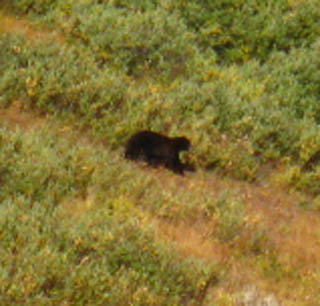
Video and Pictures of Bear Running North through Carson Gap, down to Meiss Meadow

Approaching the Gap on September 20, 2009

Bear running North through the Carson Gap

I was approaching the Carson Gap on my way from Meeks Bay to Yosemite on September 20, 2009, when I noticed something big and black coming fast down the drainage from the Gap.

Must be a bear, I though. Then I thought how glad I was that bear was using the drainage, rather than the trail, to race down from the gap. Bears use the trails too, but this bear was not on a leisurely walk, he was moving fast to get away from something.

As the bear was more concerned with fleeing something behind him than observing, the bear did not see me in its haste.

After bear passed down into Meiss Meadow, I resumed my hike up to the Carson Gap. Since the only things that make bears run are humans or other bears, I was now looking out for the day hiker or backpacker that most likely spooked the bear, causing it to run away down to Meiss Meadow.

Comments-Questions

top of page

Running Bear on the North side of the Carson Gap

  Bear in full retreat down from the Carson Gap.       Slowing a bit behind the brush cover.  
  Carson Gap Bear 1       Carson Gap Bear 2  
The bear must be doing 25 mph. But keeping a brisk pace away from the intruder.  

Video of Bear and Comments on Two-legged Trail Denizens

  Bear film shot below the Carson Gap  
   
The rest was shot at the Carson Gap Pond. The Point: Be Cool.

More Bear

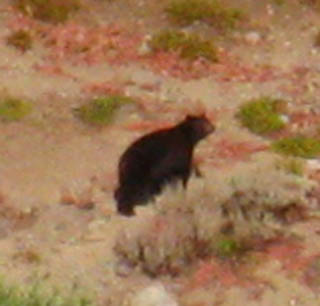
  Bear fleeing into Meiss Meadow       This bear would have shocked the shit out of any hikers coming up through Meiss Meadow...  
  Carson Gap Bear 3       Carson Gap Bear 4  
Wild Bears run from people. But there was no one coming up behind me.  

top of page

Reaching the Carson Gap in Spring and Early Summer finds the Iris Pads in full bloom
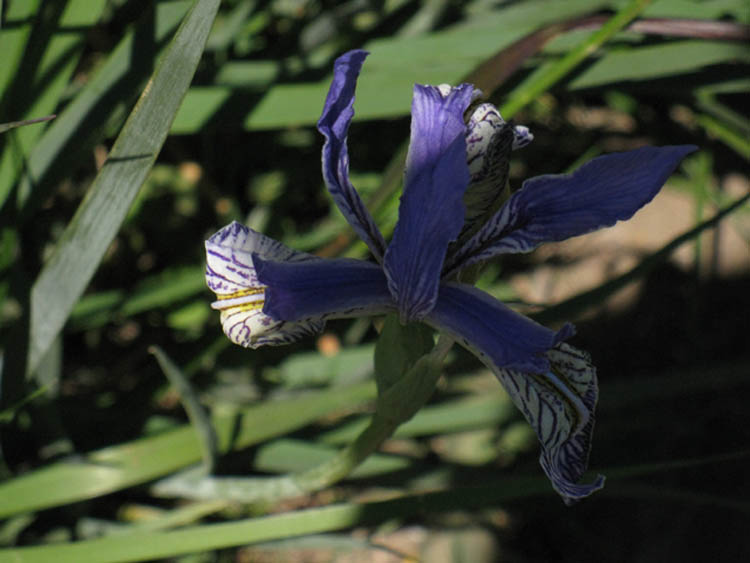
Iris in shadow


  Another Iris at the Carson Gap  
  Iris at the Carson Gap  

The Iris in the Gap is always a welcome sight in Spring.

top of page

North: Carson Gap                 South on the TY: Trail to Woods Lake.                South on the PCT: Carson Pass.

The Carson Gap Pond with Round Top and The Sisters backdrop

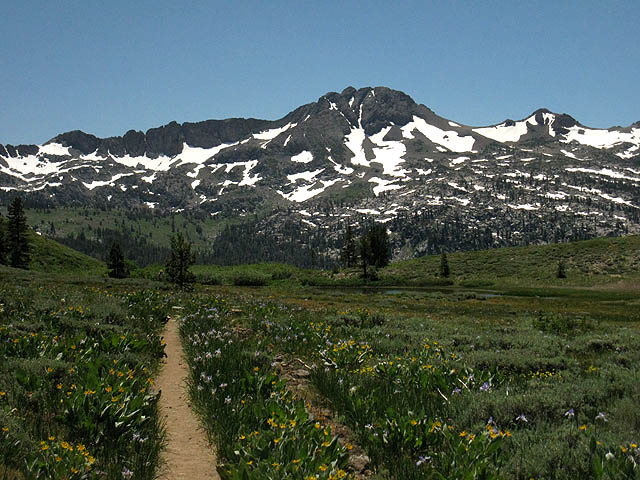
View South of the Round Top Massif through the Carson Gap.
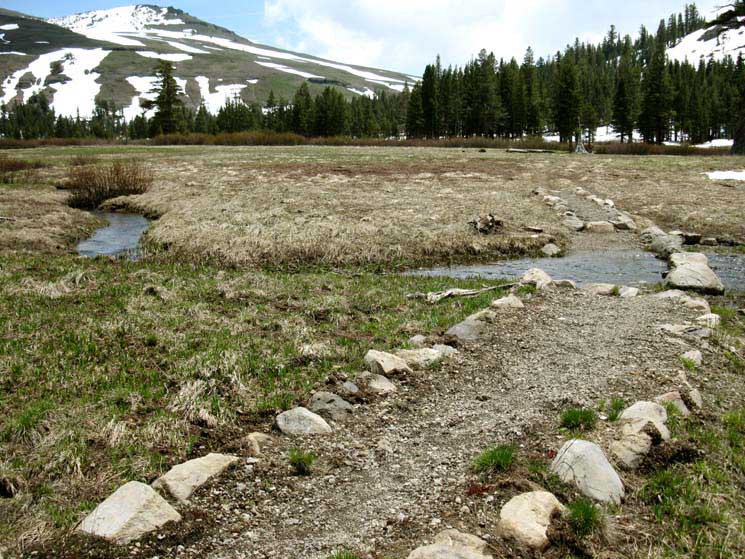
Carson Gap Pond appears
Below: Round Top and one of The Sisters dominate the Vista South of the Carson Gap.
Approaching Carson Gap. View! Carson Gap Pond!

The Carson Gap's Meadow was in full bloom.

top of page

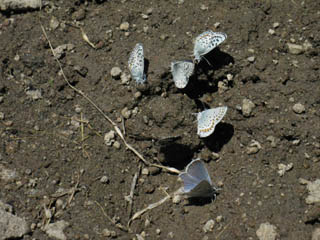
BUTTERFLIES!

Puddling Butterflies sucking salt at the Carson Gap Pond

Thanks to Professor Arthur Shapiro for identification and behavior information
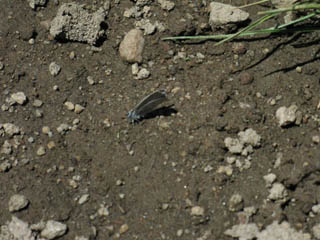
  Small pale blue butterflies were feeding on the receding wet apron of the pond in the Carson Gap.       They were fluttering on their own, when they were not holding on to keep the gusting breezes from pushing them over.  
  Moth 1       Moths!  
So I sat down with the view of Round Top before me, and the fluttering butterflies below. Between the breeze and their fluttering, they were a hard shot. Especially as this was my break!  


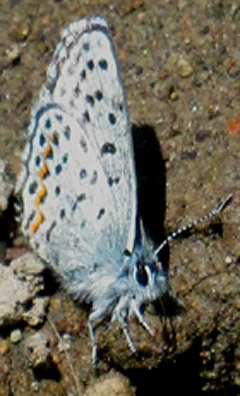
Little Blue Butterfly at the Carson Gap Pond

About the image above

Butterflies in the Sierras are beyond my ability to identify. I sought out the expertise of Professor Arthur Shapiro, who is quoted and credited for identifying the species on this page.

Professor Shapiro Says

"All easy, but you may be slightly discombobulated by the information about the little blue guys--identifying them is a skill that takes lots of practice."

"The one in the smaller upper-left picture is undeterminable at this angle."

"In the smaller upper-right picture: the 3 at the top are Euphilotes battoides. The one at 3 o'clock is Lycaeides idas anna. The one at 5 o'clock is almost certainly plebejus icarioides."

Butterflies in the Carson Gap

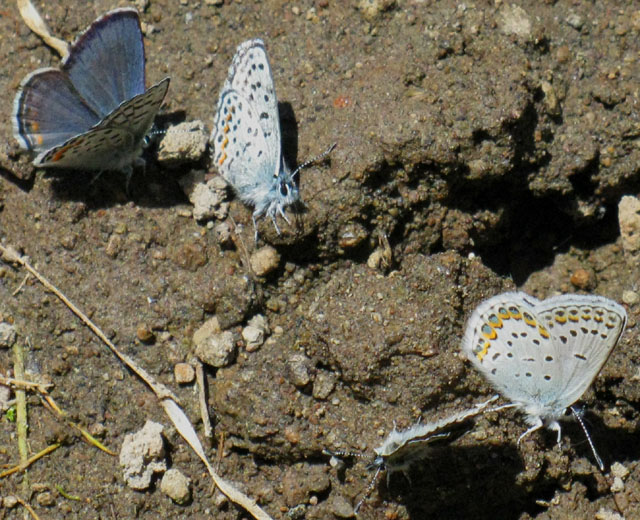
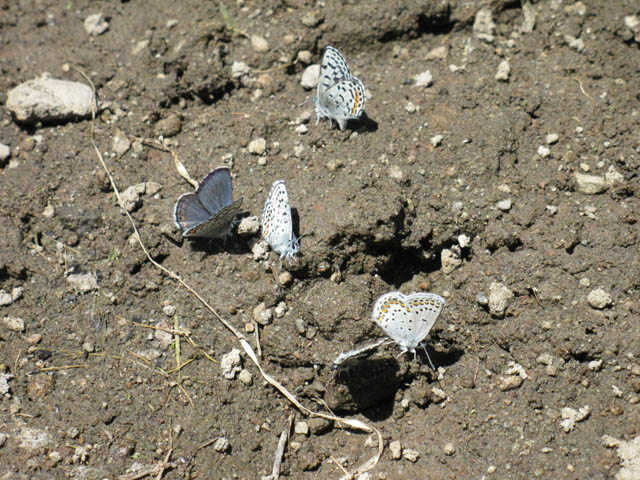
Above and Below: Blues Puddling at the Carson Gap Pond

Beautiful pale blue with orange and black checkering
Moths having a Salt Party
Their fluttering wings were a relaxing sight.


Professor Shapiro identifies the above group as a mixed-species "puddling" group, with interesting facts that have expanded my knowledge about the behavior of Butterflies.

Professor Shapiro Says:

"In the big puddling picture: At 9 o'clock, two Plebejus lupini. At 1 o'clock: E. battoides.  At 5 o'clock: 2 L.i.anna."

"These are all males and all common. Many Blues look very much alike and their males -- only males -- puddle together, but forming single-species clusters when numerous! There are others in the mix too--just not in your pictures; I've seen six different Blues on one puddle."

For more on Butterflies, See the Butterfly Section of the Backpacker's Forum

top of page

For more butterflies, or to add your own experiences, see the butterfly section of the High Sierra Backpacker's Forum

For an excellent source of Sierra Butterfly information, see

Art Shapiro's Butterfly Site

especially the

Butterfly Listing by Latin Name page, for pictures of Sierra Butterflies.

and the Professor's recent work;

Compounded effects of climate change and habitat alteration shift patterns of butterfly diversity. (abstract)

To obtain a broad understanding of Sierra Butterflies, see;

Status of Butterflies, Arthur M. Shapiro, Center for Population Biology, University of California, Davis. (pdf)

On Professor Shapiro

Professor Shapiro has contributed valuable information to our understanding of the repercussions that our alterations to our climate and ecosystem have initiated.

My hope is that our society has the wisdom to understand and properly use the information Professor Shapiro has generated to guide our legal, political, and development policies to mitigate, if not restore, our crumbling natural infrastructure.

Many thanks to Professor Shapiro not just for identifying the Butterflies pictured above, but for his dedication to understanding the Natural World, as well as his contributions to making us all aware of the importance of our interrelationship with Nature.

Comments-Questions

Carson Gap Pond with snow apron

  Early Spring with the Carson Gap Pond in the background.  
  Carson Gap Pond  

A small ice apron still sits on the pond, as well.

top of page

Two Lake Tahoe to Yosemite Trail Junctions South of the Carson Gap

#1, At the top

The first unmarked junction is just below the South side of the Carson Gap. This unmarked trail brings you straight down to Highway 88, on your way up to Round Top, in the Background.
The first cutoff to the Tahoe Yosemite Trail past Carson Gap

The Tahoe Yosemite Trail passes across the right side of the Round Top massif, pictured above, on its way down to Summit City Creek.

Following The Pacific Crest Trail South from here keeps you on the main trail that brings you down to the Carson Pass. South of Carson Pass the PCT route tracks East of Elephant Back to climb the Forestdale Divide. From the Forestdale Divide you get a glimpse of Summit City Creek and the South flank of Round Top and The Sisters, to your West, before turning South towards Ebbetts Pass.

top of page

#2 Tahoe to Yosemite Trail junction, at the base of the trail up to the Carson Gap

  The second unmarked trail junction is at the base of the Southern descent from the Carson Gap.  
  The second unmarked trail junction to the TW trail heading South through the Carson Gap  
This unmarked trail junction sits where you reach the lowest point coming off of Southern flank of the Carson Gap. This junction is located near the head of the little creek that this unmarked trail follows down to Highway 88. This junction is located where the PCT flattens out below the Carson Gap and turns East towards the Carson Pass.

top of page

North: Carson Gap                              South on TY: Trail to Woods Lake.                    South on the PCT: Carson Pass.

Let's do some Strategic Thinking

Departing the Lake Tahoe Basin Southbound

The Tahoe to Yosemite Trail

or

The Pacific Crest Trail

South to Tuolumne Meadows?

Passing South through the Carson Gap marks your point of departure from the Lake Tahoe Basin.

Independent of where you started, be it 40 miles North at Meeks Bay, 10 miles North at Echo Summit, or 8 miles coming up from the South Upper Truckee Trailhead, the terrain outside of the Tahoe Basin is going to radically change.

But how it changes depends on which way you head South out of the Lake Tahoe Basin. You have two options.

The Tahoe to Yosemite or the Pacific Crest Trail South from the Carson Gap to Tuolumne Meadows?

You have a choice of trails when you head South from the Carson Gap. First, you can head around the Southwest side of Round Top to follow the Tahoe to Yosemite Trail along the Western flank of the Sierras to Lake Alpine.

Your second option is to follow the Pacific Crest Trail through the Carson Pass, passing around the Southeast side of Round Top and Elephant Back to follow along the Eastern Flank of the Sierras to Ebbetts Pass.

Both are excellent trail routes. I suggest you hike both, as possible.


The Tahoe to Yosemite vs. The Pacific Crest Trail

Time

If we follow the Tahoe to Yosemite Trail along the Western Flank of the Sierras South from the Carson Gap, we are going to be spending roughly 2 nights hiking to Lake Alpine. We will arrive at Lake Alpine early on the second morning coming out of the Carson Gap.
I also figure on spending the same amount of time, roughly two nights and a small bit of a third day, getting to Ebbetts Pass from the Carson Pass along the Pacific Crest Trail route. You must add more or less time as necessary to suite your needs and capabilities.

The Numbers

21.41 miles from the Carson Gap to Lake Alpine via the Tahoe to Yosemite Trail. Miles & Elevations. Maps.

26.78 miles from the Carson Pass to Ebbetts Pass on the Pacific Crest Trail. Miles & Elevations. Maps.

Despite the 5 and a quarter mile difference between the two routes, mileage is not the most important distinction between the Tahoe to Yosemite and Pacific Crest Trails.

Check out the mileages coming down from Meeks Bay

top of page

Physical Differences between Routes: Climate and Terrain

The Tahoe to Yosemite route between the Carson Gap and Lake Alpine on Highway 4 traverses the Western Flank of the Sierras. The Western flank of the Sierras is generally shadier, cooler, and wetter than the PCT's route along the Eastern flank.

Besides being more exposed, hotter, and drier, the Eastern flank of the Sierras between Carson Pass and Ebbetts Pass is physically quite different in appearance than the Western Flank between Carson Gap and Lake Alpine. The vast majority of the Pacific Crest Trail along Eastern flank passes through the harsh and subtle beauties of barren volcanic terrain.

While the PCT crosses the arid volcanic terrain of Sierra's Eastern Flank with long views East, the Tahoe to Yosemite Trail submerges itself into deeply forested granitic gorges and valleys descending off of the moister Western flank of the Sierras. This moisture accounts for the denser forests on the Western Flank of the Sierras than the Eastern.

Though both routes are dry, the Western Flank's windward position, facing the Pacific Ocean, makes it noticeably greener than the Eastern Flank. Having more tree cover gives the hiker more shade, making for a cooler hike.

Psychological Difference: Much more isolated

The Tahoe to Yosemite Trail route is also much more remote and less traveled than the Pacific Crest Trail route. It is not uncommon to pass through the whole section between Summit City Creek and Lake Alpine without meeting another backpacker.

This is because of the very difficult conditions that characterize the Tahoe to Yosemite Trail between the Summit City Creek and Camp Irene on the N fork of the Mokelumne River.

top of page

Unmaintained Trail Section on the Tahoe to Yosemite Trail

The reason for the low backpacker traffic on the Tahoe to Yosemite Trail route between the Carson Pass and Lake Alpine is the rough terrain and difficult navigation demanded by the 9.52 miles of unmaintained trail between the Summit City Creek trail junction below Fourth of July Lake, to the North Fork of the Mokelumne River at Camp Irene.

Basic Conditions on the Unmaintained Sections

On an unmaintained section of trail you should expect that all signs of trail, trail bed, blazes, and ducks are absent for extended lengths. You should expect fallen trees, heavy overgrowths of brush, runoff gorges, and boulders to block your way. A wide variety of obstacles can be depended on block your route, and obscure all traces of the route you are following.

Crossing this type of terrain with a backpack is very hard work. This type of terrain demands physical conditioning and backcountry skills necessary to prevent injury while carrying a heavy pack across difficult and unstable terrain. You know you are in good enough shape when it is fun. For me this means I am running 7 miles every other day up 750 feet of elevation. Less training and preparation, less fun on the trail.

This terrain also demands the ability to find the best route in the proper direction without trail, trail markers, blazes, or ducks. Again, you know you are good to go when you enjoy the experience. If your skills are sufficient, you will find this a fun challenge. If they are not, you will find this section to be a little piece of hell.

If you are in poor condition with undeveloped route finding skills, your inability to find the easiest way through will seriously increase your workload. As your workload increases your fatigue, your ability to observe and make good decisions decreases.

In any case, projected or predicted times to make mileage on maintained trails is significantly altered by encountering unmaintained routes. It can easily take twice as long to cross a mile of an unmaintained route as it would to cross a mile of maintained trail.

top of page

Warning

Backpacking is Dangerous

Backpacking is dangerous, and can generate significant amounts of physical and psychological stress. Injury and death are regular outcomes for backpackers.

Every year backpackers get lost, injured, struck by lightening, eaten by bears, drown while crossing rivers, shot by hunters, or frozen in unexpected blizzards. These are the things that can happen to well-prepared, smart backpackers. I have not even begun to mention the things that unprepared stupid backpackers do to themselves through bad decision making.

(Example of Stupidity: Use your food bag as a pillow.)

Nothing in this trail guide will protect you against yourself or the occasional Fury of Nature.

Backpacking unmaintained trails multiplies all of these dangers, puts you further from help and/or rescue, and generally increases all of the physical and psychological stresses and dangers of normal backpacking.

It is during these hard engagements with nature that I have my best experiences. Though most of us attempt to mitigate these dangers, there is always a reasonable chance that you will get lost, get injured, or get dead.

The best way to minimize the ever-present chances of injury and death is to build your backpacking and backcountry skills and fitness in conjunction with increasing the difficulty of your backpacking trips. This way you will reduce the chances of putting yourself in situations you are not prepared for.

Don't attempt the unmaintained section of the Tahoe to Yosemite trail unless you are an accomplished, experienced backpacker, in good physical shape, capable of reading maps, with good route finding skills and properly equipped with enough food to accommodate a longer crossing of this section than you anticipated. Remember: Shit happens.

Your pace, carrying capacity, state of physical conditioning, and the particular route you choose may extend or shorten the duration of your trip through this section of the trail, and any of the trails described on this web site. Plan accordingly. Discretion is often the better part of valor.

Psychological Difference II: Much more isolated, and no maintained trails

This combination of isolation, no trails, and very hard hiking presents different obstacles than the typical long distance backpacking trip. Pressing for miles is replaced by pressing to find a route through the terrain, if you cannot locate signs of the trailbed itself. This is completely different than running down a maintained trail.

This type of travel requires careful observation, good decision making on observations, and the ability to backtrack to the point where you deviated from the best route, so you can try again.

Cross country travel produces a certain type of stress in addition to the normal stresses of backpacking. The normal stresses of backpacking are generally physical, caused by being constantly exposed to the environment, and the constant work staying in motion over the terrain demands.

Good gear mitigates the hots and colds of being constantly exposed to the elements, and constant work is offset by good eating, plenty of water, and proper rest. I find that the physical stress of normal backpacking is an excellent antidote for the psychological and physical stresses of Urban Life. One is very good for you, the other is very bad.

Cross country travel puts all stresses other than finding the proper route into secondary positions. The things that bothered you most on the trail; hunger, overheating, and exhaustion can all become inconsequential when the thing you relied on the most for your security, the trail, disappears.

It can be quite disquieting.

top of page

Take a Break

It is at just this moment, when your most basic assumption about backpacking, the trail itself, has disappeared from beneath your feet, when you must not freak out, and rebalance your approach to backpacking. Kick back and take a nice break. Have a snack and some water. Observe and Consider your situation. Food, Water, and rest are vital, and without them you will deprive yourself your ability to observe, analyze, and make good decisions.

Stop, rehydrate, fill up your water bottle, and cook up a nice hot meal and some coffee. Restore your calm approach, and your clear vision and good decision making process will follow. Always maintain your water and food consumption as you struggle to find and follow a very difficult route.


Basic Details of the Unmaintained Section between The Summit City Creek trail junction (below Fourth of July Lake) to Camp Irene

The Tahoe to Yosemite Trail's Unmaintained Section

(As of July 2009)

Between the Summit City Creek trail Junction and Telephone Gulch there is occasionally a followable trail bed, though the trail is very faint in some sections. The many downed trees require some climbing to follow the identifiable sections of the trailbed.

From Telephone Gulch to the first open rock section above the upper ford the going is really rough. You can only identify and follow the trail bed for very short sections, if at all, until it is obliterated by swaths of downed trees, completely covered and overgrown by great forests of ferns, or transformed by the Spring runoff from old trail remnants into tributaries feeding Summit City Creek. You just have to put together the best route through here as you can. If you are "on" the lay of the land you will occasionally hit small indications of the previous existence of a trail through here.

Ducks

It was recently pointed out by SandyNevada that this route was very heavily, but not very well ducked by the time she traveled it in late Summer.

Sigh. If you are not very well aware of the terrain, and completely sure you are on the optimal route, don't try to duck the route. Ducking the route reduces the enjoyment and challenge of many of the backpackers that hike through here for the challenge of navigating the terrain.

Sandy also noted that her research with the Tahoe Basin Rangers indicated that no more than 10 Tahoe to Yosemite permits are issued each year. This is not the best measure of the use of this section of trail, as many backpackers who come through here are hiking short or medium distance trips out of The Carson Pass Management Area, or coming North out of Lake Alpine.

Continuing South from Telephone Gulch

After you pass through this very rough section of highly obscured "trail," mostly composed of small bits of discrete remnants of trail bed South of Telephone Gulch, your will breathe a sigh of relief when you reach the first small section of exposed granite.
This section is easy to navigate, but it is brief, and you still have a small section of forest to get through before you reach the second section of open granite. The second section of open granite past Telephone Gulch continues South across open rock all the way down to the upper ford of Summit City Creek.

The route through this open granite section was fairly well ducked (marked by occasional stacks of differently colored rocks) in July of 2009. The problem with ducks is that Winter snows knock down most of the less secure ducks each year. So early season backpackers may not have many ducks to follow. But you should observe the piles of rocks that remain.

I find fewer ducks more stimulating than too many ducks.

Recap

To cross this section of the Tahoe to Yosemite Trail between Summit City Creek and Camp Irene you should be prepared to find your way without trail or trail signs through 9.52 +/- miles of forest, rock, and manzanita.

The conditions you may encounter through here demand that you to have the physical fitness and navigational skill to find your way through this section over difficult terrain without trails.

If you don't have these skills you will suffer and be endangered in proportion to your lack of skills.

...

South from the Upper Ford

After crossing Summit City Creek's upper ford, look to your right for the faint trail that climbs up the granite knoll sitting above the river. Don't try to continue straight up the drainage behind the ford, though it looks like the easiest way. Instead, the route turns right to roughly follow the course of the creek, but from above the creek. The rocky turmoil of sheer terrain that Summit City Creek cuts through here is what is forcing us to ford and climb up, up around this rough section of Summit City Creek.

At the top of this granite knoll you will find a small campsite with an even smaller fire ring. Continuing South, you will descend off the knoll, shortly entering a small maze of manzanita brush. Get used to it. Manzanita decorates much of the route down to the lower ford of Summit City Creek.

When your Southbound descent flattens out and you again begin to approach Summit City Creek, look West to the Creek for access to water and a couple of very nice campsites. This granite flat location sits about a mile and a third South of the upper ford of Summit City Creek.

Continuing South to the end of the flat spot, we again begin to bend East away from the creek onto the dry manzanita covered mountainside. The manzanita and heat are indicative of the elevation.
At this point we have descended down the Summit City Drainage to 6120 feet from our 9630 foot high spot crossing over Round Top, losing this elevation over 6.39 rough miles.

Of the 2.51 miles between the upper and lower fords on Summit City Creek, you will find that most of this distance is on an exposed Southern facing manzanita-covered mountainside.
These lower elevations mean that the majority of this section of trail is very hot. The heat, the exposure, and the full contact manzanita offers a multitude of route options. These factors all combine to make this a challenging descent.

The campsite on the granite flat that we are hiking past is about a mile and a quarter above the lower Summit City Creek Ford. As mentioned, this distance is mostly covered with a massive maze of manzanita, which you will have to navigate down to the second ford.

***

After the second, lower ford of Summit City Creek, a short ducked section of trail will bring you up to the entrance of a deep and dark un-blazed forest you enter passing after passing a black pond.

Making your way across this forest down into and across a unblazed forested bowl sitting on the North shore of the N Mokelumne River is pretty challenging. From there you must find where the ducked trail climbing out of the Southwest side of the forested bowl to Camp Irene is located. This too is pretty challenging. Here's my advice:

Turn left when you enter the forest past at the end of the marked trail at the Black Pond. Make your way South and downward through the forest for less than a half-mile.

Rock ridges project out to your Left from the edge of the forest, but avoid following them out, for they are dead ends. Continue South and down along the boundary between rock and forest to where the terrain begins to flatten out, and you will find seasonal drainages that runs to your left, to the Southeast, down to the N Mokelumne River. Follow the lowest of these drainages down SE into the forest filled granite bowl alongside the N. Mokelumne River.

As you follow this drainage down, you are entering a granite bowl surrounding a large flat that is densely forested. This is likely why I call it "the bowl."

If true, and you have made your way into "The Bowl," then the N Mokelumne is directly to your East, and somewhere through the forest to your West, is the steep base of the granite ridge that makes up the Western Boundary of "The Bowl." Our way out of this dense forest is located to Southwest, where we will again find an obvious trail leading up and out of this rockbound bowl through a crack in its perimeter wall. That's the trail to Camp Irene.

But before you find the trail to Camp Irene, find your way to the N Mokelumne River. Here there are fine white sand beaches along the shore, softly carpeting the floor of the dense forest that marches right up to the river. This is one of the finest remote "campsites" in the Sierras that's not real far from a trailhead.

I strongly suggest anyone entering this section have expert backpacking, map reading, and cross-country route finding skills. The Tahoe to Yosemite Trail route between the Summit City Creek and Camp Irene is difficult expert terrain.

Once you find the trail leading out of the Southwest side of the bowl, you will be relieved to see there is a well-trod trail bed, if not a fully ducked trail, the rest of the way to Camp Irene. Even when there are no ducks the trail bed should suffice to lead you to Camp Irene. The trail is actually burnished into sections of bare granite it crosses. A hundred and fifty years of even sparse traffic has left its mark on the rock.

From Camp Irene a faint maintained trail will bring you up to the crest of Mount Reba, which is the last obstacle that sits between Camp Irene and fresh food and a resupply package at Lake Alpine, the end of this trail section. We will pick up the resupply package we sent to our self at the Lake Alpine Lodge.

Once you have reached Camp Irene from the Summit City Creek, you have finished passing through the toughest part of the Tahoe to Yosemite Trail. Congratulations!

You have also passed through the end of the granite section of this part of the trail. After you cross the North Mokelumne River and begin to climb up the Northeast flanks of the Mount Reba massif, the granitic terrain that you have crossed since Summit City Creek is gradually submerged by volcanic terrain as you climb higher on Mount Reba.

OK, now go check out the TYT on the trail guide!

top of page

Below: Me, still looking for the trail out of the forested bowl along the Mokelumne River towards Camp Irene.

In the Bowl next to the N Mokelumne, just North of Camp Irene

top of page

Resupply

Two days South out of the Carson Gap on the Tahoe to Yosemite Trail will see us drop down the South side of Mount Reba to our first resupply point at the Lake Alpine lodge, located on Highway 104 on the West side of Lake Alpine.

Likewise, Pacific Crest Trail backpackers will generally hit Ebbetts Pass two days South out of the Carson Gap on the Pacific Crest Trail. Lake Alpine is a short 26 mile hitch hike to the West of Ebbetts Pass on Highway 4, where you can pick up your resupply package from Kim.

Bear Valley is three miles further West from the Lake Alpine Lodge on Highway 4.

Lake Alpine Lodge Resupply page,

(including Bear Valley and Arnold)

Resupply

Highway 4, Lake Alpine Lodge and Ebbetts Pass

The Pacific Crest trail crosses Ebbetts Pass on Highway 4. Lake Alpine, where the Tahoe to Yosemite hits Highway 4, sits about 26 miles to the West of Ebbetts Pass, also on Highway 4.

I always pick up my first resupply at the Lake Alpine Lodge, even if I am hiking the Pacific Crest Trail. This necessitates hitching a ride down down mountain from Ebbetts Pass for hikers on the Pacific Crest Trail. Hikers on the Tahoe to Yosemite Trail hit Highway 4 at the East end of Lake Alpine, and will find it a pleasant 3/4 mile walk to the Lake Alpine Lodge.

After finding my secret camp on the East side of Lake Alpine and stashing your food and gear properly, you can take a leisurely walk along the scenic North Shore of Lake Alpine down to the Lake Alpine Lodge.

Highway 108, Saint Mary and Sonora Passes

The same basic resupply situation confronts backpackers hitting Highway 108 at the Sonora Pass as it did on Highway 4. Kennedy Meadows Pack Station is 8 miles West down the mountain from the Sonora Pass. I suggest hitching the 8 miles West, down to Kennedy Meadows to resupply. You also have the option of hitching 13 miles East to the Highways 108 and 395 junction, then hitching about 25 miles South on Highway 395 to the fine little town of Bridgeport. I don't recommend heading to Bridgeport for resupply.

Kennedy Meadows is the superior resupply option in every respect. But if you do hit Bridgeport to resupply, check out Rhino's Bar and Grill. Rhino's sports pool tables, a nice cafe with great food, and a bar. US Marines, random special forces, and other military personnel from Pickle Meadow mingle with locals, car campers, hunters, fishermen, and the occasional backpacker misguided enough to head to Bridgeport for resupply. Bridgeport also has a grocery store. Bridgeport is also the Gateway to Twin Lakes, a fine Eastern entry into Yosemite's Northern Backcountry.

Don't get me wrong, I like Bridgeport a lot, its fine residents, and especially the hot springs just South of town, but Kennedy Meadows is the Superior resupply option for backpackers crossing Highway 108.

The 395 Corridor

Personally, when I am in the 395 corridor near Highway 108, I always head North to the little town of Walker, which sits 14 miles North of the Highways 108 and 395 junction. Though it has few resources, I have friends there that have always made Walker a fine place to visit.

Lake Alpine, Bear Valley, and Arnold Resupply

Kennedy Meadows Pack Station and Resort Resupply

Full Resupply Discussion: Tahoe to Tuolumne Meadows

Read more about your route options on the Pacific Crest Trail or the Tahoe to Yosemite Trail between the Carson Gap and Highway 4 on the Trail Guide Index, on the Carson Gap Trail Guide page, in the maps section, and on the miles and elevations pages.


top of page

More Information

Check the maps, mileages and elevations, and the trail guide pages for information on each route's specifics.

The route options through the Northern Sierras are approached from the perspective of resupply on the Echo Lake Chalet Resupply page. Check this page out for resupply information and options as they pertain to both the Tahoe to Yosemite and Pacific Crest Trail routes between Meeks Bay and Sonora Pass.


Also Check out the route discussion comparing the Tahoe to Yosemite and Pacific Crest Trail routes on The Backpacker's Forum

Comments?

top of page

Maps

North of the Carson Gap

7.5 minute Topo hiking Map: Echo Summit and South Upper Truckee to Carson Pass

30 min Topo hiking Map: Echo Summit and South Upper Truckee to Carson Gap

Miles and Elevations


South of the Carson Gap

The Carson Pass Region Map

SOUTH PCT miles: Carson Pass to Ebbetts Pass

SOUTH TY miles: Carson Gap to Lake Alpine

Trail Guide Pages

North: Carson Gap             South on TY: Trail to Woods Lake.       South on the PCT: Carson Pass.

top of page

Short Trips around Carson Pass & The Administrative Units

Many fine short and medium length trips can be crafted between the Carson Pass on Highway 88 North to either Echo Pass on Highway 50, or South to either Lake Alpine or Ebbetts Pass on Highway 4.

Consider doing the Tahoe to Whitney as a "Section Hiker:" Start with a backpacking trip from Meeks Bay to Echo Summit for your first section. The next Summer hike from Echo Summit to Carson Pass, followed by hiking from Carson Pass to Ebbetts Pass. Work your way from Meeks Bay to Mount Whitney one section at a time as the nature of your life permits.

Permits

The El Dorado, Toiyabe, and Stanislaus National Forests administer the regions to the South.  The Lake Tahoe Basin Management Unit sits to the North. Which one you will need to get a permit from is determined by where you begin your trip.

Generally, if you begin backpacking from anyplace to the West of Carson Pass, you will need to contact the Amador Ranger District of the El Dorado NF. If the Carson Pass is your trailhead, you will have to get a permit from the Carson Pass Cabin for all travel starting from or staying near the Carson Pass from the Carson Pass Management Area.

Check the Amador Ranger District of the El Dorado National Forest for information on the status of the Carson Pass Cabin.

If your trip starts from anywhere East of Carson Pass, the Carson Ranger District of the Toiyabe National Forest is the administering authority. Each National Forest is divided into a number of Ranger Districts. Remember, you must order your permit from the Ranger district that administers the trailhead where you are starting your trip.

Below are the contacts to find the proper Ranger District in the pertinent National Forest to obtain the permits you need. Also see the permits page.

Southbound trips beginning in, but departing the Lake Tahoe Basin Management Unit through the Carson Gap, (Such as Echo Summit to Carson Pass, 12 miles) must be obtained from the Lake Tahoe Basin Administrative Unit.

Many backpacking trips in the LTBMU do not require permits, such as backpacking trips remaining in the Meiss Roadless Area. Other areas in the LTBMU, such as Desolation Wilderness, don't just require permits, they limit the permits they issue due to overuse. I always suggest calling ahead to find out if you need a permit for your particular trip, then ordering your permit over the phone, and having them send it to you well before the start of your long-distance backpacking trip.

The Rangers like you to pick up the permit at their station on your way to the trailhead, but that can be difficult when I'm taking public transportation and hitch hiking to the trailhead. The Rangers will generally send me the permit when I explain my situation to them.

If you are planning to begin your backpacking trip in one Administrative Unit or National Forest and are subsequently hiking into or through different National Forest or Wilderness Areas beyond the one issuing your permit, make sure you get a permit, even if a permit is not required for your starting trailhead. A permit will be required for all the subsequent National Forests and Wilderness you travel through.

Also make sure you name all of your campsite locations in the subsequent National Forests and administrative units on your permit. This can save a lot of problems when your hike brings you through a large number of National Forests, Wilderness, and especially when you cross through special administrative or management units that experience heavy backpacker traffic, such as when we cross Yosemite, in the Mount Whitney Zone, and Carson Pass Management Area.

If you listed campsites in special zones on your permit, the special zones are obliged to honor your permit.

In any case, I suggest calling the National Forest that your trip begins in to avoid confusion about permitting policies, trailhead permit boxes, and permits that cross multiple administrative units, all to make sure you can get the permit you need for your trip without hassle or undue delays at the trail head the day you want to depart.

Oh, and although the Meiss Country Roadless Area does not require permits they do require Fire Permits, even for camp stoves.

***

Exiting the Tahoe Basin South through the Carson Gap puts us into the Carson Pass Management Area of the El Dorado National Forest on both the Tahoe to Yosemite and the Pacific Crest Trail routes. The Mokelumne Wilderness also begins here, but many cut-outs make this wilderness boundary very complicated. Starting Southbound trips into, or from the Carson Pass Management Area requires you get your permit at the Carson Pass Cabin.

Tahoe to Yosemite South of Carson Pass

On the Tahoe to Yosemite Trail we exit the Carson Pass Management Area when we pass Southbound by Fourth of July Lake on our way down to Summit City Creek. From Fourth of July Lake we remain in the El Dorado National Forest administered section of the Mokelumne Wilderness until we cross the North Mokelumne River at Camp Irene. At Camp Irene we are crossing into the Stanislaus National Forest administered section of the Mokelumne Wilderness.

Thus short-distance backpacking trips Southbound out of the Carson Pass to Lake Alpine or Ebbetts Pass will require permits from the El Dorado National Forest at the Carson Pass Cabin. Northbound hikers out of Lake Alpine or Ebbetts Pass on Highway 4 will pick up their permits from the Calaveras Ranger District of the Stanislaus National Forest.

Pacific Crest Trail

South of Carson Pass we are in the El Dorado National Forest for a short distance, then the remainder of the trail to and through Ebbetts Pass down to Sonora Pass remains in the Toyiabe National Forest.

Overall

Heading South from trailheads in the Tahoe Basin to and through Carson Pass on your way down either the Pacific Crest or Tahoe to Yosemite Trails requires you obtain your permit from the Lake Tahoe Basin Management Unit.

If you start your Southbound trip from Carson Pass you can get your permit at the Carson Pass Cabin.

Comments-Questions

top of page

The Administrative Units

The Toiyabe National Forest extends down the Eastern flank of the Sierras from North of Lake Tahoe South down to where it wraps around the Northeastern boundaries of the Yosemite National Park. The Toiyabe National Forest manages both the Mokelumne and Carson-Iceberg's Eastern sections between the Carson and Sonora Passes. The Toiyabe National Forest is huge.

The Western Flank is administered by a series of National Forests. The Lake Tahoe Basin Management Unit administers the whole Lake Tahoe Basin. South of the Tahoe Basin from Carson Pass to Camp Irene the El Dorado National Forest administers the Western Flank of the Mokelumne Wilderness, while the Eastern side of the Mokelumne Wilderness sits within the Toiyabe NF.

The Carson-Iceberg Wilderness spans both flanks of the Sierra Crest South of Highway 4 down to Highway 108. Again, the Eastern Flank is administered by the Toiyabe NF, while its Western Flank is part of the Stanislaus NF.

South of Highway 108 both the PCT and TY trails enter the Stanislaus NF Administered sections of the Emigrant Wilderness. The Southbound hiker on the Pacific Crest Trail will enter the Toiyabe NF for the short section from Kennedy Canyon to where they enter Yosemite through Dorothy Lake Pass.

The Tahoe to Yosemite Backpacker will be in the Emigrant Wilderness administered by the Stanislaus National Forest from Kennedy Meadows until they enter Yosemite through Bond Pass.

Climate and Terrain

The Eastern slope is noticeably drier than the Western side of the Sierras. This is because most of the moisture in the air passing over the Western Slope is drawn out as it climbs over across the crest. This leaves little moisture for the Eastern Sierras, and almost none for the mountains beyond.

This same process turns super-heated moisture-laden air blown West from the Valley on hot Summer Days into massive expanding thunderheads as they climb the Western flank of the Sierra Crest. So be careful, and keep an eye out for afternoon thunderstorms forming along the Sierra Crest over all the trails during Summertime. These storms can be quite violent. Lightening presents a very serious danger to High Sierra backpackers during these storms, so be careful and watchful.

Don't get caught out on a high altitude exposed mountainside when one of these storms forms up. I have postponed crossing open meadows during thunderstorm activity.

The volcanic terrain along the Sierra's Eastern Flank compliments its dryness. The PCT route along the Eastern Slope is dominated by starkly beautiful volcanic features, until you approach the East Fork of the Carson, (South of Ebbetts Pass past Wolf Creek Pass, and 5 miles North of Sonora Pass.) which defines a beautiful interface zone between local pink-hued granites and the surrounding volcanic overlays on the granite.

You will trace this interface from the East Fork of the Carson through the Emigrant Wilderness, until you begin climbing to the Boundary of Yosemite National Park at Dorothy Pass. From there it's all granite, all the way to Tuolumne Meadows.

The volcanic/granite terrain interfaces that surround Yosemite, to both the North and South, fall away as you enter Yosemite. Yosemite stands as a great granite island in the vast sea of mixed volcanic and granite terrain that surrounds it.

top of page


Trips North from Highway 4 to Highway 88

If you are hiking North from Lake Alpine on the Tahoe to Yosemite Trail to the Carson Pass, you will need to obtain your permit from the Calaveras Ranger District of the Stanislaus National Forest. If you depart from Ebbetts Pass for the Carson Pass on the Pacific Crest Trail, you will have to contact the Carson Ranger district of the Toiyabe National Forest for your permit.

The Pacific Crest Trail South from Carson Pass

Southbound on the PCT we will hit Ebbetts Pass after two nights heading South from the Carson Gap, and Sonora Pass after roughly six nights on the trail, including a day off at Lake Alpine. Of course your timing depends on your plans, carrying capacity, and daily mileage. You must make your hiking plans to reasonably suit your particular needs, goals, and capacities.

Following the Pacific Crest Trail South out of the Carson Gap shortly brings you a couple of miles Southeastward down to Carson Pass. From here the Pacific Crest Trail continues South along the Eastern slope of the Sierra Crest to Ebbetts Pass on Highway 4.

Shortly after departing Carson Pass you will be entering the Toiyabe National Forest, within which you remain as you backpack across the Eastern Sections of the Mokelumne Wilderness to Ebbetts Pass, and on to the Sonora Pass.

Both the Southbound Pacific Crest and Tahoe to Yosemite trails depart the Mokelumne Wilderness at Highway 4, and both shortly enter the Carson-Iceberg Wilderness until Highway 108. South of Highway 108 hikers on both routes enter the Emigrant Wilderness of Stanislaus National Forest on their ways to their respective entries into Yosemite.

The Pacific Crest Trail Hiker will enter Yosemite through Dorothy Lake Pass, while the backpacker on the Tahoe to Yosemite enters through Bond Pass, less than a mile South down Jack Main Canyon from Dorothy Lake Pass.

Both the Tahoe to Yosemite and Pacific Crest Trails shortly converge at the head of Jack Main Canyon after entering Yosemite.

South of Highway 4 to Yosemite: Yet More Route Options!

The 34.64 miles Southbound on the Tahoe to Yosemite Trail that separates Lake Alpine and Saint Marys Pass also stay on the Western flank of the Sierra down to Highway 108. Saint Marys Pass is located a mile West of where the Pacific Crest Trail passes through Sonora Pass on Highway 108. Though the PCT and TYT take a divergent course through the Sierras South of Highway 4, they draw close together where they meet Highway 108.

Check out this Big Map which highlights the differences between the Tahoe to Yosemite and Pacific Crest Trail routes between Carson Pass and Highway 108.

The Pacific Crest Trail

South of Ebbetts Pass on the Pacific Crest Trail the mountains seem to thicken. Rather than a quick drop off the Eastern flank of the Sierras with long views East, as was typical for much of the distance between Carson Pass and Ebbetts Pass, our 26.78 mile hike between Ebbetts Pass and Sonora Pass has more and larger ridges separating the Sierra Crest from the Eastern escarpment of the Sierra. The long view East you enjoyed North of Ebbetts Pass are now regularly obscured by big mountain ridges and their intervening drainages. The nature of the terrain the Pacific Crest trail passes through South of Highway 4 also changes.

The raw harshness of the volcanic terrain that we experienced North of Ebbetts Pass coming across Raymond and around Reynolds Peaks on the Pacific Crest Trail continues to be moderated by thickening sections of forest.

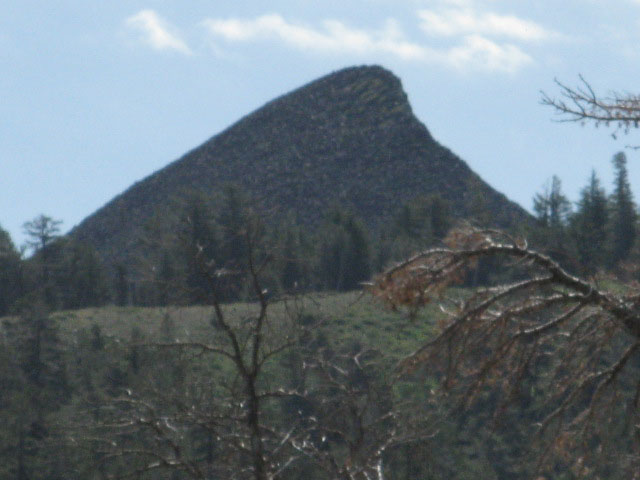
As we head South past Noble Lake and over a shoulder of Tyron Peak we are still crossing volcanic terrain. As we head South of Asa Lake the volcanic terrain is now occasionally being broken up by sections of fine metamorphic rock formations. These formations rear up out of the Sierra crest line like great mountainous shark fins.

Sharkfin formation on the Pacific Crest Trail approaching Murray Canyon trail junction

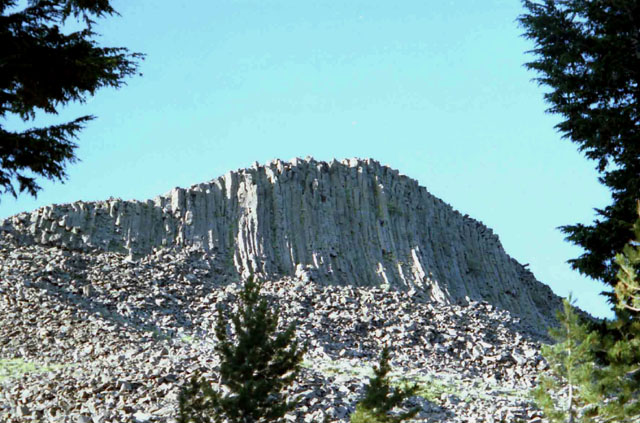
Upon closer inspection, some of these formations are reminiscent of the hexagonal columns of of slow cooling metamorphic rock similar to that which produced Devils Postpile.

Metamorphic Rock shark fin similar in character to Devils Postpile

Continuing South from the junction with Murray Canyon, we begin crossing an interface zone between the fine granites lining the East Carson River, the metamorphic rock zone approaching Murray Creek and the volcanic crestline continuing South to and through Sonora Pass, represented by the great volcanic masses of Sonora, Stanislaus, and Disaster Peaks making up the Western flank rising from the West shore of the East Carson River. Great granite mountains rise from the East shore of the East Carson. It's quite a remarkable place.

At this point in time I have only completed the guide from the Tahoe Basin down to Highway 108, and I am really enjoyed adding information from this amazing portion of trails. Check out the Carson Iceberg Wilderness section of the trail guide.

The Hybrid Route

Because I want to pass through these various terrains along the Pacific Crest Trail I prefer to alter my Tahoe to Yosemite route to cover the best bits from both the Pacific Crest and Tahoe to Yosemite trails between Highway 4 and Highway 108. Though I follow the Tahoe to Yosemite Trail South from the Carson Gap departing the Lake Tahoe Basin through Lake Alpine, I almost always switch over to the Pacific Crest Trail halfway between Highway 4 and Highway 108.

I follow the Tahoe to Yosemite Route South out of the Eastern side of Lake Alpine as normal for a Tahoe to Yosemite hiker, but my destination is not Saint Marys Pass, where the Tahoe to Yosemite trailhead is located on Highway 108, but the Sonora Pass trailhead of the Pacific Crest Trail, which is located a mile East of Saint Marys Pass.

On the East Side of Spicer Reservoir I depart the Tahoe to Yosemite Trail to follow Highland Creek up to the Sierra Crest. After passing by Highland Lakes and crossing Gardiner Meadow I turn South on the PCT at Wolf Creek Pass. This will bring me through the beauties of the East Carson River on my way to Sonora Pass. I prefer this hybrid route to simply following the Tahoe to Yosemite Route from Lake Alpine to Saint Marys Pass or the Pacific Crest Trail from Ebbetts Pass to Sonora Pass.

This way, on my Tahoe to Yosemite-Pacific Crest hybrid route, I start on the TYT at Lake Alpine, and hike up to the Sierra Crestline to catch the PCT South to Sonora Pass, rather than continue along the Western Flank of the Sierra on the Tahoe to Yosemite Trail to Saint Marys Pass. Though the great valleys along the Western flank of the Sierras to Saint Marys Pass are excellent backpacking terrain, I prefer my hybrid route to hiking straight through on one or the other routes between Highway 4 and Highway 108.

Review: Tahoe to Yosemite Route Options

The point of all of these words is to express that you have many route options between Lake Tahoe and Yosemite. I stitch together my favorite pieces of both the Pacific Crest and Tahoe to Yosemite trails hiking between Lake Tahoe and Tuolumne Meadows in Yosemite. Your trail options begin in the Tahoe Basin, where you can pick your own starting trailhead to begin your trip.

At the Carson Gap you exit the Tahoe Basin, and you have a choice between the Tahoe to Yosemite or Pacific Crest Trail route South to Highway 4.

As you can now see, you have a variety of route options on your hike South between Highway 4 and Highway 108. The options South from Highway 108 multiply.

East Carson Drainage

South from Highway 108: Excellent Trail Options

When you arrive at Highway 108, at either Saint Marys Pass or Sonora Pass, you will hitchhike 9 miles down to the Kennedy Meadows Pack Station, also on Highway 108, where your second (or third) resupply will be waiting for you with Cheryl. Tell her hi from Alex!

At both Lake Alpine on Highway 4 and the Kennedy Meadows Pack Station on Highway 108 we can rest up a bit, eat some good food, have a beer, hang out with the fishermen, locals, car campers, staff, hunters, and cowboys, and pick up our resupply for the next section of our run South to Tuolumne Meadows.

At Kennedy Meadows Pack Station we decide if we will continue South on the Tahoe to Yosemite Trail by hiking up Summit Creek out of Kennedy Meadows Pack Station to cross the Emigrant Wilderness into Yosemite, or you can hitch-hike back up to Sonora Pass to continue South on the Pacific Crest Trail over Leavitt Peak, to follow the West Walker up to the Yosemite boundary.

Man, I like both routes a lot! The TYT South from KM hikes up by Relief Reservoir past Granite Chief to cross the amazing Emigrant Basin to enter Yosemite through Bond Pass into the top of Jack Main Canyon. This is amazing terrain.

The Pacific Crest Trail, on the other hand, swings around the Emigrant Basin to follow the granite terrain of the West Walker River up past a series of stunning lakes to Dorothy Pass Lake, where you will enter Yosemite at the top of Jack Main Canyon, just above where the Tahoe to Yosemite Trail enters the Canyon.

The Pacific Crest Trail hiker can alter their route to pass through Emigrant Basin between Big Sam and Bond Pass, bypassing the West Walker River between Kennedy Canyon and Dorothy Pass Lake.

All of these routes from Highway 108 to Jack Main Canyon are awesome, and it has been interesting to hike each one many times. I learn and see new stuff every time through.

Comments-Questions

top of page

Backpacking Trail Guide Pages from Carson Gap

North

Pacific Crest & Tahoe to Yosemite Trails

Carson Gap

South

Pacific Crest Trail


Carson Pass

South

Tahoe to Yosemite Trail

Trail to Woods Lake

Backpacker Forums

Have General Information about Backpacking to relate ?

Post it on: TahoetoWhitney.Org

Post your comments and questions on the relevant Pages in this Forum, or Register to post your own pages about your trips and the trails through the Meiss Country Roadless Area in the Echo Summit to Carson Pass Forum.
Forum: Echo Summit to Carson Pass
Page: The Carson Gap
Discuss: Tahoe to Yosemite or Pacific Crest Trail?

  North: Carson Gap          South on Tahoe to Yosemite: Trail to Woods Lake.   South on the Pacific Crest Trail: Carson Pass.

Home Page
Contact Alex Wierbinski

top of page

Frosted Backpack

Backpacking Lake Tahoe to Mount Whitney

Your guide to the High Sierra Crest, including the Tahoe to Yosemite, Pacific Crest, and John Muir Trails
Snug tent after Snow Storm
© Lake Tahoe to Mount Whitney: Crown Jewel of the Pacific Crest Trail